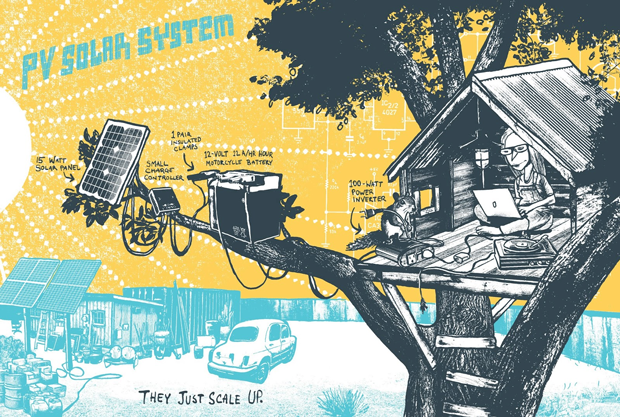
Grid-independent systems can be called island systems, off grid systems or battery systems. The basic equipment used in the system is solar panel, battery, charge controller, inverter and tracker. In places where there is no grid line or no functional electricity grid, the healthiest solution is to install an accurately calculated off grid system according to need.
The installation of battery systems in the places where the electricity line is located increases the system cost and increases the system turnaround times. For this reason, the places where these systems are installed are mostly places where there is no mains power or more than 800m from the transmission line. Especially in highland-chalets, farms, signaling systems, remote information systems (highway signs), base stations etc. Such installations are frequently encountered. The withdrawal of the transmission line in such places constitutes a serious cost of transformer, pole and cable.
The most important advantages of systems ;
• In case of lack of network, economic solution
• Convenient and feasible compared to the cost of the network connection,
• No fuel costs,
• Qualified but few personnel are sufficient in installation,
• Installation time is short,
• Systems can be increased according to energy needs.
• Systems can be installed in stages, so there are flexible installation costs.
Issues to be considered while designing the system can be listed as follows:
• The first thing to do is to replace the existing equipment in the place where the system is to be used with the energy saving products. In this way, the amount of energy consumed will decrease. In some applications, system costs are thus reduced by half.
• Then it is necessary to know what the daily consumption is. In order for this to be done, it is necessary to list the number of hours which home appliances are run in the installation place. With this list, the daily / weekly energy needs of the house will be determined and the system account will be realized according to this information.
• Preliminary work where the system is to be installed is important in terms of installation design and identification of connection equipment. In addition, the presence of objects / structures that can cast shadow on the panels should be examined carefully. If the panels are arranged sequentially one after the other, the distance between the panels should be selected and the panels should not shade on each other.
• System design and whether the place is a summer home or a year-long residence is a serious impact on system design and costs. Panel design is made according to the worst seasons conditions.
• If the place used is a seasonal or summer house, it is necessary to know which house is used between the months. In the sizing, system calculations are made based on the radiation values in the summer months.
• In this case, the calculated system cost corresponds to almost half of the system cost according to the bad conditions. The design should be calculated according to usage time and season so that system cost should be optimized.
• The choice of inverter is important when designing the system. According to the devices to be used according to the amount of energy taken at the appropriate voltage and power inverter should be calculated. The most important issue to be considered in the inverter to be selected is that the devices used (motorized appliances such as refrigerators) are capable of removing the inrush current. The discharge current can be up to 3-4 times the nominal current. The inverter supply must be capable of removing this current according to the device specifications.
• 428/5000 If the area where the system will be installed will be the roof, the roof direction and slope should be calculated in detail. The construction to be installed should be mounted so as not to damage the roof insulation. If the system is to be installed in the garden, it can be installed with fixed feet or assembled by following the sun. Depending on whether the tracker is single or biaxial, the amount of energy produced can be increased by 15-35%.
• The housing of the battery groups is very important for the life of the batteries. For this reason, the location of the batteries should be considered as well as the autonomy period when designing the batteries. The location of the batteries is very airy, it is very effective in preventing the heating of batteries.
• During the transport of energy as DC, the amount of energy lost as the distance increases can reach considerable amounts. For this reason, the distance between the devices to be used (solar panel-battery-inverter) should be minimum. In addition, cable should be used in appropriate section.
• After the completion of the system account, the autonomy time will be determined according to the annual / seasonal use of the house and the energy requirement of the house.